


Written by Kathrine | Last updated 31. October 2024 |
0 comments
Written by Kathrine | Last updated 31. October 2024 |
0 comments
EV Charging in Denmark
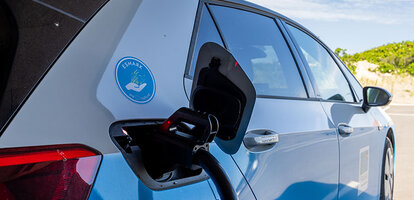
Denmark is a dream destination for electric car drivers! Charging your car on a holiday home holiday is wonderfully easy, thanks to a dense network of public charging stations (or ladestandere, as we say in Danish) all over the country and along the West Coast.
Best of all, you never need to worry about running out of power in the middle of your holiday. Public chargers are spread across the whole country, so you can charge quickly and easily wherever your trip takes you.
If you notice your battery running low while driving in Denmark, there is no reason to panic. In the larger Danish towns you will find a charger on almost every corner. You can also charge at most big car parks, shopping centres and supermarkets. On the Danish motorways, especially the E45 through Jutland and the E20 across Funen and Zealand, the rastepladser (motorway service areas) and petrol stations offer fast chargers that give your car a quick boost.
When you drive from one sight to the next and need to top up, you will always find a charger nearby. The Danish network is not limited to cities and motorways. With apps like PlugShare you can find chargers close to where you are, and you will see that many of our holiday home areas (sommerhusområder) have public chargers too. Denmark has plenty of charging providers, among them Clever, E.ON, Ionity and Spirii. Fun fact: Clever and Spirii are all Danish companies, which says a lot about how seriously we Danes take electric driving.
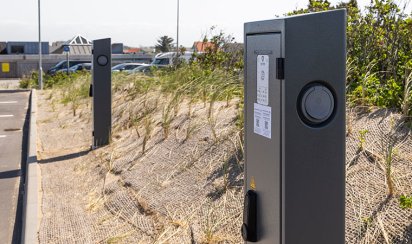
Wherever you are on the West Coast of Jutland, you will find plenty of places to charge. In holiday towns like Söndervig, Hvide Sande, Henne Strand and Blävand there are public chargers close to shops and supermarkets. You can charge while you buy groceries, have an ice cream at the harbour or enjoy a walk on the beach, and drive back to your holiday home with a full battery, ready for the next adventure.
With Esmark you can even find a holiday home with its own EV charger, so you can charge your electric car right outside the door. That makes your electric car holiday in Denmark completely carefree.
The different types of charging stations in Denmark
When you travel around Denmark, you will soon notice that there are several types of chargers. These are the most common ones:
Normal chargers (AC): Danes often call these normalladere or destinationsladere. They charge at up to 22 kW and are found in public car parks, at supermarkets, shopping centres, hotels, harbours and in many holiday home areas. At most of them you need to bring your own charging cable. Private chargers often have a fixed cable, but we still recommend taking your own cable on your holiday in Denmark.
Fast chargers (DC): Known in Danish as hurtigladere, they typically deliver around 50 kW and come with a fixed cable. You find them at petrol stations, rastepladser and larger shopping areas, and they are perfect for a quick top up on the way to the coast.
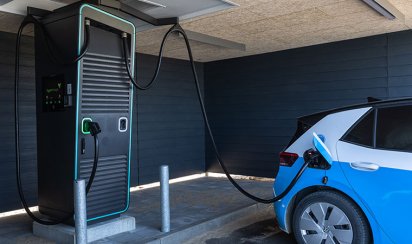
High power chargers: The lynladere are the fastest way to charge, typically from 150 kW and up to 350 kW or more. They are mostly located along the motorways and at big charging hubs, for example the architect designed charging site on the motorway near Fredericia.
Tesla Superchargers: These were originally built for Tesla cars and are found at strategic locations along the main roads. A growing number of Danish Superchargers are now open to other electric cars as well, via the Tesla app.
Parking at charging stations
In Denmark you will find many parking bays reserved for electric cars, either at dedicated charging parks or as part of ordinary car parks. The signs usually tell you that the bay is for electric cars while charging only. So respect the parking rules and move your car once it is fully charged, so other drivers can charge too. Many operators also charge an idle fee (in Danish: blokeringsgebyr) if your car stays plugged in after charging has finished. It pays off, quite literally, to keep an eye on the app.
Bring your own charging cable on your trip
At fast chargers you usually do not need your own cable, as they have fixed cables. We still strongly recommend packing your own cable for your holiday, because many normal chargers do not have a fixed cable, and then your own cable is what gets you charging.
Here are some guidelines on when to bring your own cable:
Normal AC chargers with up to 22 kW usually require your own Type 2 cable. Most electric cars come with a Type 2 cable that fits these chargers.
DC fast chargers and lynladere, which can deliver up to 350 kW, have their own fixed cables. You do not need to bring a cable for these.
Destination chargers at hotels, shopping centres, attractions or holiday home areas may require your own cable.
So it is always a good idea to check in advance whether you need your own cable before you drive to a specific charger.
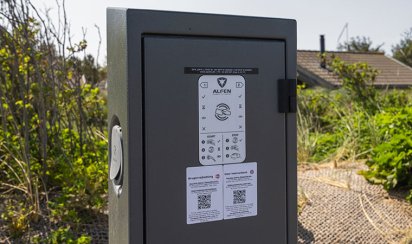
Public chargers with a fixed cable or a fixed plug do not let you connect your own cable. Here you can only use the plug that is installed on the charger.
Charging plugs used in Denmark
Denmark uses the same charging plugs as the rest of Europe. The most common one is Type 2, the standard plug for AC charging. It fits most electric cars and is available at almost every normal charger in the country.
Type 2 is not the only option, though. For fast and high power charging, CCS (Combo 2) is the standard in Denmark. It combines the Type 2 plug with two extra pins for fast DC charging.
You can also find CHAdeMO plugs in Denmark. CCS has become the dominant standard, but some older electric cars, such as earlier models of the Nissan Leaf, still use CHAdeMO. There are far fewer CHAdeMO chargers than CCS and Type 2 chargers, and the number is falling as older chargers are replaced. If your car uses CHAdeMO, check in advance where you can charge, especially before longer stretches of your route.
Paying at charging stations in Denmark
When you are on holiday in Denmark and need to charge your electric car, paying is easy. Danish chargers offer several ways to pay.
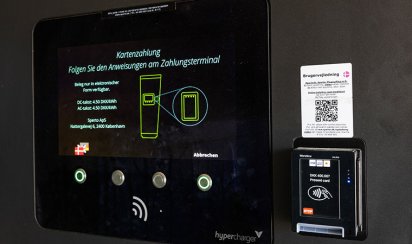
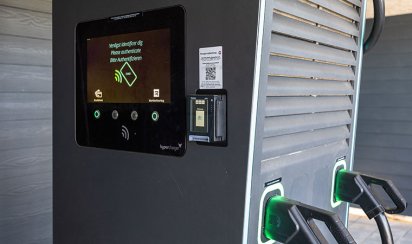
At many chargers you can pay with your credit or debit card, often contactless directly at the terminal. EU rules require new public chargers to offer payment without a subscription, and fast chargers from 50 kW and up will have to accept card payment directly. At other chargers you pay through an app or a charge card. Most public chargers have a QR code you scan with your phone, which takes you to a payment page or the operator’s app. Simple and convenient.
There are many apps you can use to pay. Each network has its own app, so you may end up installing a few. Some of the most popular in Denmark are Clever, Spirii, E.ON Drive and Shell Recharge. If you already have a charge card or a roaming app from home, such as Plugsurfing, it often works at Danish chargers too.
If you are not sure where the nearest charger is, apps like PlugShare, Chargefinder or A Better Route Planner will help you find one. Prices vary from operator to operator, and charging without a subscription is usually a bit more expensive. Many Danish operators also change their prices during the day, and late afternoon and early evening is typically the most expensive time to charge. Always check the price at the charger or in the app before you start.
So lean back, enjoy your holiday and let the beautiful Danish West Coast enchant you while your car charges. The chargers are there to make your holiday as carefree as possible. We look forward to welcoming you!
Charging time at charging stations
How long it takes to charge your electric car at a Danish charger depends on several things: the type of charger, the size of your battery and how much power you need.
Normal AC chargers are the most widespread. They charge more slowly because they deliver less power, which makes them ideal while you shop, eat or spend the night in your holiday home. When you are in a hurry, fast chargers and lynladere are the heroes of the day. You find them at petrol stations along the motorways and at large shopping centres.
The higher the output of the charger, the faster your battery charges.
Keep in mind that not every car can handle the maximum power of the fastest chargers. Your car decides how much power it accepts, and charging slows down as the battery fills up, especially above 80 percent. On a chilly day on the West Coast a cold battery also charges more slowly. Check your car’s technical data before your holiday, so you know what to expect at the different chargers. Then your electric car trip in Denmark will be smooth from start to finish!
We regularly update our map with additional disposal options and endeavour to be accurate. However, please note that we rely on information from external public systems, which may contain outdated or inaccurate data. Do not hesitate to contact us if you discover any errors.
Follow Esmark
Follow Esmark on Facebook and Instagram! We keep you updated on new holiday homes, competitions, photos, news from the holiday coast, and much more.


Esmark Newsletter - become VIP
Get our newsletters with exciting travel tips and great offers on holiday home vacations in Denmark. Every 3 months, we draw a winner for an Esmark gift card worth DKK 3,500 among all recipients.
Categories:
Tips til sommerhusferien
Meet the author – Kathrine Frydendahl Høj
I was born and grew up in Hvide Sande. But I also lived in Aarhus while I was studying marketing economics. I hadn't quite finished my studies before I moved back to Hvide Sande, so it was ideal to commute to Herning to study a part-time Bachelor's degree in International Trade and Marketing. I graduated from the University of Applied Sciences in January 2023 and have been working at Esmark ever since, being part of a wonderful team with great colleagues. I like to spend my free time with my family and friends.
Write a reply
Your email address will not be published but will only be used to secure the blog against spam and to contact the winner directly in connection with any competitions.
Required fields are marked with *